Exterior Wall Components: Air Barriers, Vapour Barriers and Insulation for Maximum Energy Efficiency

Walls play a vital role in the overall performance of buildings. Poor insulation or insufficient airtightness can lead to energy loss, water, air and moisture infiltration, and premature degradation of materials, thus compromising the comfort and durability of the structure.

To ensure optimal protection, it is essential to use suitable solutions, such as air barriers, vapour barriers and high-performance insulation. These components work together to limit heat transfer, prevent moisture-related problems and improve the building’s energy efficiency. Discover our complete line of solutions for wall insulation and airtightness, designed to ensure long-lasting performance and optimal comfort.

Discover Our Products for Walls

Wall under construction covered with SOPRASEAL STICK AVB AT, overlooking the riverWall under construction covered with SOPRASEAL STICK AVB AT, overlooking the river

Air/Vapour Barrier

An air/vapour barrier combines the functions of an air barrier and a vapour barrier in a single membrane. Installed on the exterior support panel of wall assembly with exterior insulation only (perfect wall), this membrane resists air leakage, water infiltration and water vapour diffusion.

Permeable Air Barrier

The main purpose of a vapour permeable air barrier is to prevent air leakage through the building envelope while allowing water vapour to escape. Installed on the exterior side, this membrane helps improve energy efficiency by reducing heat loss caused by drafts.

Multihousing building façade under construction covered with SOPRASEAL STICK VP air barrier from SOPREMAMultihousing building façade under construction covered with SOPRASEAL STICK VP air barrier from SOPREMA
Worker in protective suit spraying SOPRA-SPF 200 polyurethane foam insulation on interior wallWorker in protective suit spraying SOPRA-SPF 200 polyurethane foam insulation on interior wall

Sprayed and Blown Insulation

Insulation is essential for limiting heat loss and improving the energy efficiency of buildings. SOPRA-CELLULOSE, an ecological solution made from blown cellulose fibres, is ideal for insulating ceilings and interior walls. SOPRA-SPF, a sprayed polyurethane foam, provides continuous insulation without thermal bridges, for both interior and exterior applications. These products easily adapt to irregular shapes and help create high-performance building envelopes.

Rigid Insulation

For applications requiring high-performance panels, SOPREMA also offers various rigid insulation products. SOPRA-ISO V, made of polyisocyanurate, stands out for its excellent thermal insulation performance. SOPRA-XPS, made of extruded polystyrene, offers high water and moisture resistance and is ideal for more demanding environments. These rigid solutions are perfect for optimizing the overall energy performance of the building.

Wall under construction with SOPRA-ISO V insulation panels installed on a buildingWall under construction with SOPRA-ISO V insulation panels installed on a building
Close-up of SOPRASEAL STICK 1100T membrane with ACS thermal clipsClose-up of SOPRASEAL STICK 1100T membrane with ACS thermal clips

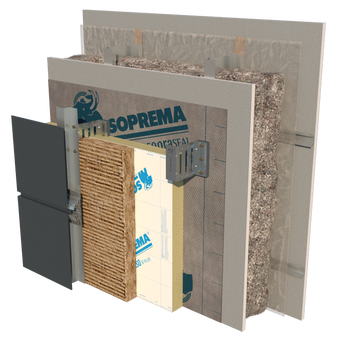
ACS THERMAL CLIPS

ACS THERMAL CLIPS constitute a high-performance exterior cladding support system. Made of stainless steel and a thermal pad, they reduce the effects of thermal bridges in wall assemblies. They come in two configurations—solid and adjustable—and can be used with all types of insulation materials.

Benefits of SOPREMA Wall Products

With SOPREMA products, you will benefit from advanced technologies to ensure the insulation and airtightness of your walls. Our solutions are designed to meet the requirements of the most complex projects, ensuring high thermal performance, effective protection against air and moisture, and exceptional durability. Discover their benefits:

Comprehensive Solution

A complete line of tested products and systems for walls, including air barrier and vapour barrier membranes, insulation, thermal clips and air barrier system accessory products (sealants, mastics, primers, and more).

Easy installation

Products designed for efficient implementation on site, compatible with different installation methods, such as self-adhesive, heatwelded, mechanically fastened or liquid-applied.

High Performance

Excellent resistance to air and water infiltration, high thermal performance and compliance with building code requirements.

Expert Technical Support

Personalized support, from product selection to implementation, backed by SOPREMA’s recognized expertise.

Full Line of Tested Products and Systems for Walls

At SOPREMA, we offer wall systems tailored to every type of building. From insulation to air/vapour barrier membranes, each component is designed to optimize the thermal performance and durability of buildings. Discover our line of products to choose the ideal exterior wall components for your project.

SOPREMA product range for wall waterproofing and insulationSOPREMA product range for wall waterproofing and insulation

Solutions for All Types of Foundations

The nominal R-value is simply the sum of the R-values of all the components in an assembly, perpendicular to the heat flow. For example, an R-6 per inch insulation has a nominal R-value of 18 if three inches of it is applied. The R-values of other elements, such as support panels, and air spaces can then be added.

As for the effective R-value, it is the thermal resistance of an assembly considering the effect of thermal bridges. This is the actual thermal resistance provided by the assembly. Depending on the configuration of an assembly and the fastening systems, it is entirely possible to have an assembly whose effective thermal resistance is half its nominal resistance.

When we talk about overall thermal resistance, we are trying to assess the effective thermal of multiple components. In the case of a facade, there are different wall configurations (particularly with secondary frame elements), which we try to put together to get an idea of its “overall” performance. To do this, it is necessary to consider the effective thermal resistance of all the elements involved.

Section 3.1.5 of the 2020 National Building Code (the Canadian model code), which deals with non-combustible construction, begins by requiring that all non-combustible construction be made of non-combustible materials. This statement is qualified by the following articles in the same section, which provide relaxations for the addition of combustible elements in non-combustible construction.

These relaxations include permission for the use of combustible components in exterior walls (such as insulation), contingent upon the successful completion of a full-scale test (CAN/ULC-S134). SOPREMA successfully completed such a test with the Protected Assembly (using SOPRA-ISO V).

Standards S741 and S742 are specification standards referenced in the 2020 National Building Code, the Canadian model code. When we refer to a specification standard, we mean that it not only describes how to test and report values, but also clearly defines performance thresholds to be achieved.

CAN/ULC-S741 covers air barrier materials and provides air permeance requirements for materials at a pressure difference of 75 Pa.

As for CAN/ULC-S742, which covers air barrier assemblies, the installation of the air barrier membrane is reproduced on a substrate supported by a frame. In simple terms, the test involves subjecting the assembly to wind pressures, which structurally stress the assembly. At the membrane level, these pressures are intended to challenge the adhesion of the products. Once these structural loads have been applied, the test specimen is removed and checked for airtightness. This airtightness is therefore assessed after having subjected the assembly to conditions which risk causing mechanical damage to the system, mainly delamination.

Manufacturers can choose the pressures and supports for which their products will be tested. Depending on the pressures chosen, CAN/ULC-S742 specifies the height of buildings on which it is acceptable to use the assembly. This height varies according to the climatic data provided by the National Building Code for different Canadian cities. For the same test pressures, an air barrier assembly may be permitted in one city at a given height, and restricted to a lower height in another city.

In general terms, non-permeable vapour barriers are defined as materials that have a high resistance to water vapour transmission. These are “vapour-tight” materials. Permeable vapour barriers, on the other hand, allow the transmission of water vapour in certain extent.

Apart from the purchase price, the design of the insulation system can be optimized to reduce material costs.

First, materials that conduct less thermal energy (higher R-value per inch) can be chosen to reduce the thickness needed to achieve the same R-value for all the walls.

Second, the entire exterior cladding system must be considered, as the fastening system constitutes a thermal bridge. Fastening systems must then be analyzed from several angles, including structural and thermal ones. To determine thermal performance, we can refer to the efficiency percentage of the fastening system. For example, with a 50% efficient fastening system, materials with a nominal R-value of 30 provide an effective R-value of 15. Half of the R-value is lost due to thermal bridging. With a 90% efficient fastening system, materials with a nominal R-value of 30 provide an effective R-value of 27. It is therefore much more economical to opt for a system that ensures good retention of the nominal R-value (i.e. the R-value the customer is aiming for).

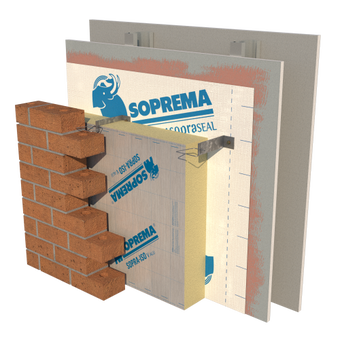
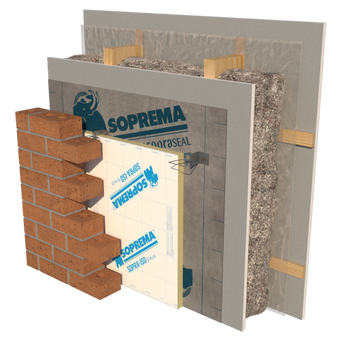
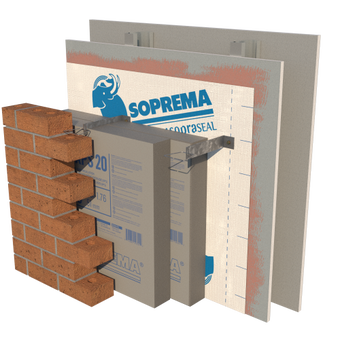
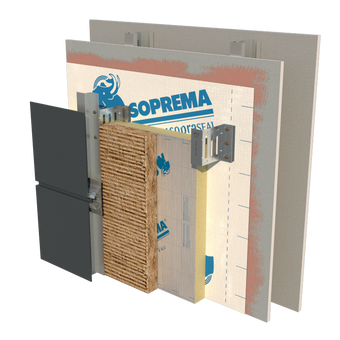
Perfect walls are described as walls where all of the insulation is outside the wall cavity (containing the frame). The term “perfect” is subjective and it doesn’t mean there are “impeccable” walls and “imperfect” walls. A more objective way to describe them would simply be to say that they are walls insulated from the outside.

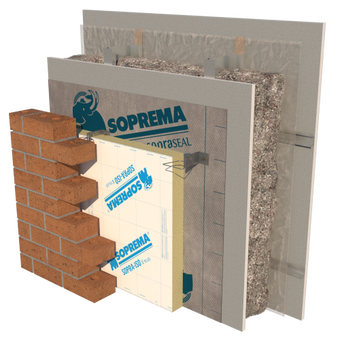
As for hybrid walls, they have insulation inside the wall cavity (between the studs) as well as outside the cavity.

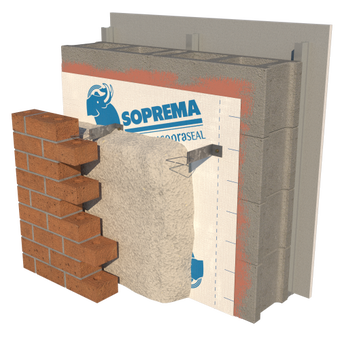
Wall Assembly Systems

SOPREMA wall assemblies offer the most effective combinations of products for maximizing the durability and energy efficiency of buildings. All our systems have been tested to meet the highest performance standards in the industry and comply with current Canadian standards.
Toolbox

Any questions?

Our experts are there to support you with your projects.

1 of 3
2 of 3
3 of 3
Please use a bigger screen than 1024px to compare products. Close

Share Exterior Walls Components: Insulation and Airtightness | SOPREMA